Sewer Line Repair & Replacement in Fort Myers, FL
A camera goes down the line before any repair gets recommended — so you know exactly what's wrong before you pay to fix it.
What Sewer Line Repair Actually Involves
A sewer line problem isn't one thing — it's a spectrum. Root intrusion, an offset joint, a belly where the pipe has sagged and started collecting waste, or a fully collapsed section all show up as the same symptoms upstairs: slow drains, gurgling toilets, sewage smell in the yard. The only way to know which one you're actually dealing with is a camera inspection, which is why we connect you with a licensed local pro who runs the camera before recommending anything. Guessing at a fix based on symptoms alone is how homeowners end up paying for a repair that doesn't address the real problem.
Once the camera shows what's actually wrong, the method depends on what it found. If the pipe is still structurally sound but damaged along one stretch, CIPP lining — a resin-saturated liner cured in place inside the existing pipe — can rehabilitate it without digging up the yard, but it only works if the remaining pipe wall has enough integrity left to bond to. If the pipe itself is brittle, badly cracked, or offset (common with old clay and cast iron), pipe bursting is often the better call: a bursting head is pulled through the old pipe, fracturing it outward into the surrounding soil, while new fused HDPE pipe is pulled in right behind it. Lining repairs pipe that's still sound. Bursting replaces pipe that isn't. Both avoid the trench a full excavation requires.
Neither trenchless method works in every situation. A severe belly or sag in the line won't be fixed by lining, since the liner just follows the same shape the damaged pipe already has. A complete collapse leaves no continuous path for a bursting head to pull through, which forces traditional excavation instead. This is exactly why the diagnosis has to come before the recommendation — the right fix depends entirely on what's actually down there, not on which method happens to be easiest to sell.
Signs Your Sewer Line Needs Attention
Multiple drains in the house slow or backing up at the same time
Toilets gurgle when you run water in a sink or shower
Sewage or rotten-egg smell inside the house or out in the yard
Wet or soggy patches in the yard with no clear cause
Unusually green or fast-growing grass along one path in the yard
Sewage backing up in the lowest drains in the house — floor drains, basement or garage tub
Standing water near the foundation after rain that takes longer than the rest of the yard to dry
Cracks near where the line exits the house, if the line runs shallow
A single slow drain is usually just a fixture clog. But when more than one drain is affected at the same time, the problem is almost always in the main line — worth a camera inspection rather than another round of snaking.
How Sewer Line Repair Works
Camera Inspection First
A camera gets run through the line to find cracks, offsets, root intrusion, or corrosion, and to confirm what the pipe is actually made of.
Diagnose the Damage
The exact location, cause, and severity get identified before any method gets recommended — repair, reline, or replace.
Choose the Right Fix
Depending on what the camera shows, that might mean CIPP lining, pipe bursting, a localized spot repair on one damaged section, or full excavation and replacement.
Confirm With a Final Inspection
A follow-up camera pass confirms the repair actually worked and water is flowing the way it should.
Why This Comes Up Here
Fort Myers' sandy soil shifts more than denser soil types, and that steady movement puts ongoing stress on pipe joints — especially in older neighborhoods still running clay or cast iron rather than PVC. Clay and cast iron are jointed materials, which makes them more vulnerable to both root intrusion and infiltration than a fused modern pipe, and it's often the real reason an older Fort Myers home needs a full line replacement rather than a simple repair.
Root intrusion shows up constantly along McGregor Boulevard and other mature, tree-lined corridors, where decades-old root systems have had plenty of time to find their way into older lines through hairline cracks and loose joints. Root intrusion is the cause of more than half of all sewer line blockages nationally, and a corridor with mature trees and older pipe is exactly the combination that makes it a recurring problem here rather than a one-time event.
Hurricane season adds another layer of stress most homeowners don't think about until it hits. Heavy rain and ground saturation can push an existing crack or offset joint into a full failure, which is a real part of why sewer line calls spike during the wettest months of the year.
What Sewer Line Repair Typically Costs
Camera inspection typically runs $230 to $845, and it's the step that determines everything else — skipping it and going straight to a repair quote is one of the most common ways homeowners end up paying for a fix that doesn't match the actual problem.
CIPP lining for a typical residential lateral generally runs $70 to $250 per linear foot, with a full lateral (40–75 feet) commonly totaling $4,500 to $9,500. Pipe bursting runs a similar $60 to $200 per linear foot, with a full whole-house job typically $3,500 to $12,000. For comparison, traditional trench excavation and replacement runs $150 to $450 or more per linear foot once restoration is factored in, and full replacement often lands in the $2,000 to $10,000 range depending on length and access.
A localized spot repair — fixing one damaged section rather than the full line — typically runs $2,500 to $6,000.
These are typical ranges, not a quote. Your actual cost depends on the length and diameter of the line, the extent of the damage, and site access.
Example Job — McGregor Boulevard Corridor, Fort Myers
The Problem
A homeowner along one of the older, tree-lined streets off McGregor Boulevard noticed the upstairs toilet gurgling every time the washing machine drained, along with a faint sewage smell near a low spot in the side yard that never quite dried out.
The Diagnosis
A camera inspection found root intrusion through a joint in the home's original clay sewer line, about 20 feet from the foundation — consistent with the mature oak canopy along the street. The pipe itself was still structurally sound outside the intrusion point, making it a candidate for lining rather than full replacement.
The Fix
The connected contractor cleared the root mass mechanically, then installed a CIPP liner through the existing line from an access point near the cleanout, avoiding excavation of the yard or the driveway. A post-repair camera pass confirmed clear flow and full coverage of the lined section.
Recurrence Prevention
Because the surrounding line runs under the same mature root canopy, a camera inspection every two to three years is a reasonable way to catch any new intrusion early — the lined section itself is now joint-free at that spot, but the rest of the original clay line further down isn't.
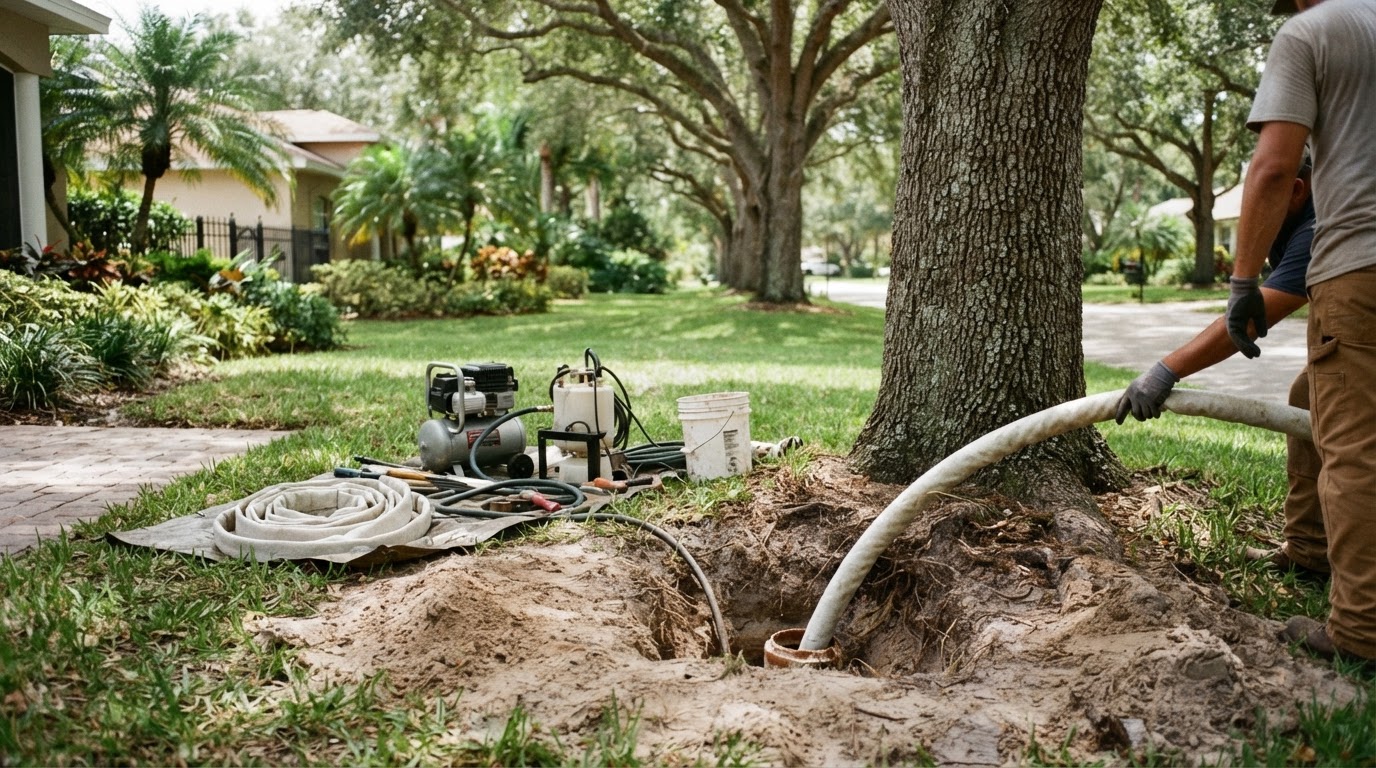
Trenchless lining access point — root intrusion repair along a tree-lined Fort Myers street
| Item | Cost |
|---|---|
| Camera inspection / diagnostic | $250–$400 |
| Root clearing (mechanical) | $350–$600 |
| CIPP lining, single section | $2,500–$4,500 |
| Total | $3,100–$5,500 |
Costs vary by scope, access, and site conditions — this reflects a typical root-intrusion lining scenario and is not a quote. A quick call to your connected professional will confirm exact pricing for your property.
Why Fort Myers Homeowners Call Us
We Show You the Problem
A camera inspection happens before any repair is recommended, so you see the same footage we do — not just a verbal description.
Licensed and Verifiable
Every pro in our network is licensed for this work in Florida. You can check any contractor at myfloridalicense.com before work starts.
Repair Options, Not Just Replacement
We connect you with pros who evaluate trenchless lining and pipe bursting before ever recommending a full dig-and-replace.
Local Knowledge
We connect you with pros who understand Fort Myers' sandy soil, older neighborhoods, and the corridors where root intrusion shows up most.
Areas We Serve
Fort Myers, Cape Coral, North Fort Myers, Iona, San Carlos Park, Buckingham